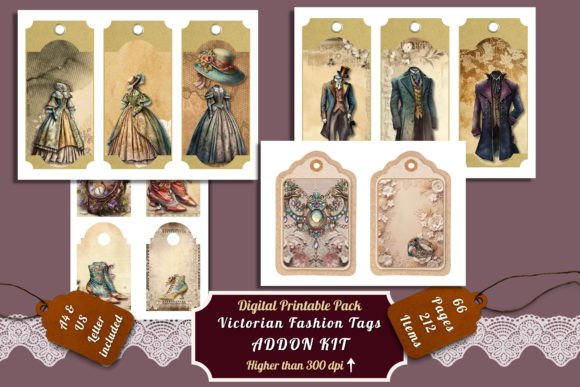
Elevate Your Projects with Victorian Fashion Tags
There is a specific, almost magnetic pull to the textures of the past. In a digital world saturated with sleek, flat vectors, the tactile illusion of Victorian ephemera offers a refreshing sense of depth. For designers, scrapbookers, and content creators, the challenge often lies in sourcing assets that feel authentic without spending hours in Photoshop trying to artificially age a paper texture. This is where the Victorian Fashion Junk Journal Tags Pages Kit steps in, bridging the gap between historical elegance and modern utility.
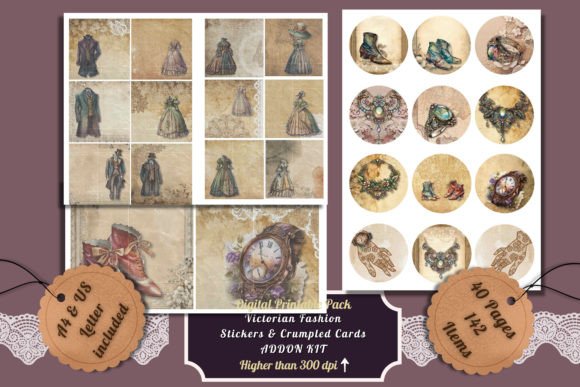
This isn't just a generic set of vintage cutouts. It is a curated collection of 212 distinct items spread across 66 pages, designed to capture the opulence of the Victorian and Edwardian eras. The visual language here is rich and layered. You are dealing with the aesthetics of corsets, bustles, intricate lace, and heavy drapery. The personality of these tags is undeniably romantic and nostalgic, evoking a sense of refinement and storytelling. For the creative professional, this kit serves as a high-quality design asset that can instantly add "patina" to a project, suggesting a history that predates the project itself.
Visual Characteristics and The "Vintage Paper" Appeal
When evaluating a kit like this, the details matter. The strength of the Victorian Fashion Journal Tags Pages Kit lies in its versatility regarding format. With both A4 and US Letter sizing included, it removes the friction of resizing for international users. More importantly, the files are provided as high-quality JPGs at 300 DPI or higher. This is a non-negotiable requirement for anyone working in editorial design or packaging design. Low-resolution assets pixelate when printed, destroying the illusion of quality. Here, the crispness ensures that the fine details of the lace textures and typographic elements remain sharp, whether you are printing them at full size or scaling them down for social media graphics.
The "junk journal" aesthetic is particularly effective because it embraces imperfection. Unlike a sterile, corporate serif font or a rigid grid system, these tags offer organic shapes. They function as visual anchors. If you are designing a mood board for a brand identity that needs to convey heritage, luxury, or artisanal craftsmanship, these tags provide the perfect backdrop. They act as a display font for the eyes—communicating style through imagery rather than just letters.
Practical Applications: From Digital to Print
How does a set of vintage tags fit into a modern workflow? The applications are broader than one might initially think. For the graphic designer or marketer, these assets are excellent for creating layered web design hero sections. Instead of a flat background color, using a faded Victorian tag as a background element adds depth and texture. It creates a visual hierarchy that draws the eye, allowing you to layer modern, clean sans serif fonts on top for a striking contrast between old and new.
For small business owners and entrepreneurs, specifically those in the handmade, stationery, or boutique fashion sectors, these tags are a goldmine for packaging design. Imagine a clothing brand that uses these tags as hang-tags for garments, or a baker wrapping goods in parchment and sealing them with a printed Victorian ephemera sticker. It elevates the unboxing experience, making the product feel premium and thoughtfully curated.
Furthermore, for content creators and bloggers, these pages are a lifesaver for "flat lay" photography. If you are shooting a product or a recipe, scattering a few of these printed tags around the subject adds an immediate stylistic flair to your Instagram feed or Pinterest boards. It helps maintain a consistent aesthetic without requiring complex editing skills.
Strategic Integration and Design Recommendations
Integrating a premium font or asset kit requires a strategic approach to ensure it enhances rather than clutters your work. When using the Victorian Fashion Junk Journal Tags Pages Kit, consider the following practical guidelines to maximize your return on investment:
- Contrast is Key: Victorian fashion is ornate and highly detailed. To maintain readability and a clean visual hierarchy, pair these tags with clean typography. A modern sans serif font or a minimal geometric typeface works best. Avoid using overly decorative script fonts alongside the tags, as the visual noise will compete for attention and reduce engagement.
- Color Grading: While the kit comes with its own vintage color palette, don't be afraid to apply color overlays in your editing software. If your brand identity uses specific colors, you can tint these tags to match, ensuring they feel like a cohesive part of your system rather than a pasted-on afterthought.
- Layering for Depth: In editorial design, use these tags as "spot" elements. Place them behind pull quotes or use them as page markers. The 3D illusion of the tags creates a sense of physical space on a digital page, making the layout feel more immersive.
- Commercial Potential: Always review the licensing for commercial use. Assuming the license permits it, these assets can be used to create physical products for sale—such as junk journals, card making kits, or art prints—providing a tangible revenue stream for crafters and hobbyists.
Ultimately, the value of the Victorian Fashion Journal Tags Pages Kit lies in its ability to tell a story. It is not merely decoration; it is a narrative tool. By incorporating these elements, you are tapping into a visual language of history, elegance, and intricate beauty. Whether you are a publisher looking for unique chapter headers or a hobbyist building a personal memory book, this collection offers a robust foundation for creativity that feels both timeless and deeply personal.